Does a Faceless YouTube Channel Make Money? Yes, With Limits
Faceless YouTube channels earn the same way any channel does: ads, affiliate links, sponsorships and products. This explainer covers the Partner Program rules, the inauthentic-content policy, RPM math and per-video costs, without relying on income screenshots.

AutoShort Editorial Team
Guías de vídeo corto
12 de noviembre de 2026 · 18 min de lectura
A faceless YouTube channel is a channel that publishes videos without the creator appearing on camera, using voiceover, AI narration or AI visuals instead. Does faceless YouTube channel make money? Yes. Faceless channels earn through the same Partner Program ads, affiliate links, sponsorships and products as any channel, provided the videos are original, varied and meet YouTube's monetization rules.
Key takeaways
- Faceless channels earn by the same methods as face-on-camera channels. YouTube pays for watched videos, not for a face.
- Ad revenue starts only after you join the YouTube Partner Program (YPP): 1,000 subscribers plus 4,000 watch hours in 12 months, or 1,000 subscribers plus 10 million Shorts views in 90 days.
- No single income figure can be verified. Ad revenue follows views ÷ 1,000 × RPM, and RPM shifts with niche, audience country, video length and season.
- YouTube's inauthentic-content update targets repetitive, mass-produced videos. The policy page does not mention faceless channels.
- AI production can run from about $1 to $10 per Short, so cost control matters while you wait for monetization.
Does faceless YouTube channel make money? Yes, with conditions
A faceless channel makes money when it reaches YouTube's monetization thresholds or sells something to its audience, and when its videos pass YouTube's originality rules. The missing face does not block income. Repetitive, template-driven content does.
The short answer: yes, if the videos are original and varied
YouTube's Partner Program does not require you to appear on camera. It requires an audience (subscribers plus watch hours or Shorts views), a clean policy record and content that follows the channel monetization policies.
Descript defines three faceless formats:
- No visual presence: the creator never appears, and the video relies on footage, graphics or screen recordings.
- Voice-only: the creator narrates over visuals.
- AI voice plus visuals: both narration and imagery are generated.
All three can be monetized. The condition that matters is originality. A channel that publishes the same template with a swapped topic risks losing monetization, faceless or not.
Why no one can verify a single income figure
There is no reliable average income for faceless channels. Trezalabs argues that no single revenue figure can be verified because RPM depends on five variables:
- Advertiser demand in the niche
- The share of views that actually carry ads
- Audience country
- Video length
- Season
The big numbers you see online are unsourced. Descript says many faceless channels earn "five to six figures annually" but gives no source. Nexlev, a vendor, claims you can "realistically make $5,000 to $10,000 a month" and that some creators hit "$20K, $50K+ per month". None of those claims are backed by published data. Treat them as marketing, not benchmarks.
Do faceless channels earn as much as face channels?
Faceless channels can earn as much as face channels because both use the same revenue methods. Descript states faceless channels can generate "just as much income" as traditional ones.
YouTube pays per monetized view, and sponsors pay for audience reach. A face can help with trust and personal branding, which affects sponsorship deals. It does not change how ad revenue is calculated.
How do faceless YouTube channels make money?
Faceless channels make money through six revenue lines: YouTube ads, affiliate links, sponsorships, digital products, merch and donations or crowdfunding. Ads are the slowest because they wait for Partner Program approval. The other lines can start earlier.
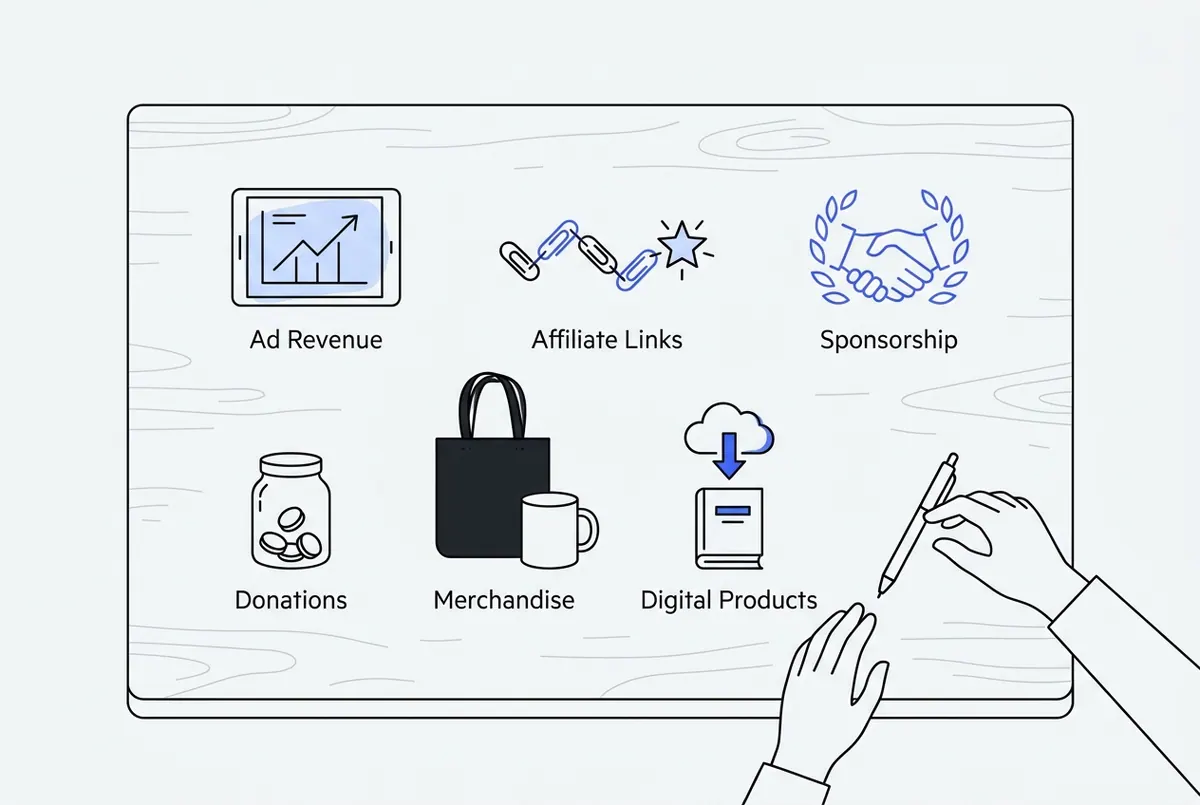
AdSense and YouTube Partner Program ads
YouTube Partner Program (YPP): YouTube's program that lets eligible creators share in ad revenue from their videos, paid through a linked AdSense for YouTube account.
Ads are the default goal for most faceless channels. Trezalabs calls ads the slowest revenue line, because you earn nothing from ads until you pass the eligibility threshold and the review.
Long-form videos earn from ads shown on the video. Shorts earn from a pooled model, covered in the payout section below.
Affiliate links and sponsorships
Affiliate links pay a commission when viewers buy through your link. They fit faceless formats well: product explainers, software walkthroughs, finance breakdowns and tool comparisons.
Sponsorships pay a flat fee or a per-view rate for a mention. Sponsors care about audience fit and engagement, not about whether you appear on camera. Trezalabs notes that affiliate links and sponsorships can both start before the YPP threshold.
Digital products, merch and donations
Descript lists digital products, merch, crowdfunding and donations as additional revenue lines.
- Digital products: templates, guides, courses, spreadsheets or presets linked to your niche.
- Merch: branded items, which work best when the channel has a recognizable name or mascot.
- Crowdfunding and donations: recurring support from loyal viewers, usually through external membership platforms.
Trezalabs recommends selling your own product from day one, because product revenue does not depend on YouTube's approval.
Which revenue lines can start before monetization
Four of the six revenue lines can earn before you join YPP. Only ads require approval.
| Revenue stream | Needs YPP? | Speed to first dollar | Main risk |
|---|---|---|---|
| YouTube ads (long-form and Shorts) | Yes | Slowest: threshold plus about 1 month review | Rejection or demonetization for inauthentic content |
| Affiliate links | No | Fast, from the first video with a link | Low commissions or irrelevant products hurting trust |
| Sponsorships | No | Medium, once you have a measurable audience | Few offers for small or low-engagement channels |
| Digital products | No | Fast if the product exists | Time to build the product |
| Merch | No | Slow, needs brand recognition | Low demand for anonymous brands |
| Donations and crowdfunding | No | Slow, needs a loyal audience | Small, unpredictable amounts |
What do you need before YouTube pays you?
YouTube pays ad revenue only after you join the Partner Program. That requires 1,000 subscribers plus either 4,000 qualified watch hours in 12 months or 10 million qualified Shorts views in 90 days, plus policy compliance, a linked AdSense account and an approved review.
Two routes: 4,000 watch hours or 10M Shorts views
The YouTube Partner Program overview and eligibility page lists two routes to full ad-revenue eligibility:
| Route | Subscribers | Second requirement | Window |
|---|---|---|---|
| Long-form | 1,000 | 4,000 qualified watch hours | Last 12 months |
| Shorts | 1,000 | 10 million qualified Shorts views | Last 90 days |
One detail trips up Shorts creators: watch hours from the Shorts Feed do not count toward the 4,000-hour threshold. A channel that posts only Shorts must use the 10-million-views route or add long-form videos.
Other requirements and the review timeline
Hitting the numbers is not enough. YouTube also requires you to:
- Follow the YouTube channel monetization policies
- Live in a country where YPP is available
- Have no active Community Guidelines strikes
- Turn on 2-Step Verification for your Google account
- Have access to advanced features on YouTube
- Link one active AdSense for YouTube account
After you apply, YouTube reviews the channel as a whole, using automated systems and human reviewers. The review takes "typically in about 1 month", according to YouTube Help. The same page also carries a banner about updated YPP terms starting February 1, 2027, so check it before you apply.
Do you get paid after 1,000 views?
No. YouTube does not pay at 1,000 views. Payment depends on YPP membership, not on a view count. A video can pass 1,000 views and earn nothing from ads if the channel has not been accepted.
Once you are in YPP, every monetized view contributes to revenue. The 1,000 figure you see in RPM and CPM metrics is just the unit used to measure earnings per thousand views.
What happens if you are rejected
YouTube gives you two options after a rejection:
- Appeal within 21 days of the decision.
- Reapply after 30 days, or after 90 days if it is not your first rejection.
Because reviewers look at the whole channel, fixing one video rarely solves a rejection. Remove or rework repetitive videos before reapplying.
Here is how income typically sequences for a new faceless channel. The phases are illustrative, not a forecast.
| Phase | What happens | Possible income |
|---|---|---|
| Launch | Publish consistently, test formats | Affiliate links, own product |
| Growth | Audience builds toward 1,000 subscribers | Affiliate, product, first small sponsors |
| Threshold reached | Apply to YPP | Same as growth phase |
| Review (about 1 month) | Automated and human review | Same as growth phase |
| Accepted | Ads switch on for long-form and Shorts | Ads plus all earlier lines |
| Rejected | Appeal within 21 days or reapply after 30/90 days | Non-ad lines only |
How much can a faceless channel realistically earn?
A faceless channel earns views ÷ 1,000 × RPM from ads, plus whatever its affiliate, sponsor and product lines bring in. No verified average exists. The realistic way to estimate is to choose a conservative RPM for your niche and calculate the views you would need.
RPM by niche and why it varies
RPM (revenue per mille): the amount a creator earns per 1,000 views after YouTube's share, across all views including those without ads.
Nexlev claims RPM "can range anywhere from $2 to $20+" by niche, with finance "over $10". This is an unverified vendor claim. Trezalabs makes a directional point that is easier to defend: finance, software, business and education earn more per view than entertainment and ambient content, because advertisers pay more to reach those viewers.
RPM also moves with factors you control only partly: audience country, video length, the share of views carrying ads and seasonal advertiser budgets. Your own YouTube Analytics is the only RPM figure worth planning with. For a deeper niche breakdown, see this list of faceless niches that monetize.
Worked example: views needed for a target income
Use this formula as an illustration, not a prediction:
Ad revenue = (monthly views ÷ 1,000) × RPM
Rearranged for a target income: views needed = (target ÷ RPM) × 1,000.
Take a $1,000 monthly ad income target and the two ends of Nexlev's claimed range:
- At a $2 RPM: ($1,000 ÷ $2) × 1,000 = 500,000 views per month.
- At a $20 RPM: ($1,000 ÷ $20) × 1,000 = 50,000 views per month.
That tenfold gap is why niche choice matters more than upload count. Plug in your own RPM once you have analytics data.
Shorts vs long-form payout
Shorts and long-form videos pay on different models. According to the YouTube partner earnings overview, a partner who accepts the Shorts Monetization Module receives 45% of the revenue allocated to them, based on their share of Creator Pool views. Long-form videos earn from ads served on the video itself.
| Factor | Long-form | Shorts |
|---|---|---|
| YPP threshold | 1,000 subs + 4,000 watch hours in 12 months | 1,000 subs + 10M Shorts views in 90 days |
| Payout basis | Ads served on your video | 45% of revenue allocated from your share of Creator Pool views |
| Pros | Higher control over ad inventory; longer watch time | Fast to produce; strong discovery |
| Cons | Slower to produce; harder to get clicks | Very high view threshold; pooled revenue |
For Shorts-specific tactics, read this breakdown of how to monetize YouTube Shorts.
How many views for $10,000 a month?
Using the same formula, $10,000 a month from ads alone needs:
- 5,000,000 monthly views at a $2 RPM
- 1,000,000 monthly views at a $10 RPM
- 500,000 monthly views at a $20 RPM
These RPMs come from Nexlev's unverified range, so treat the results as orders of magnitude. Example channels cited online, such as the 3D crime documentary channel Fern that Nexlev puts at "around $80K+ a month", are unsourced. Channels at that level usually combine ads with sponsors and products.
Does YouTube demonetize AI-generated faceless channels?
YouTube does not demonetize channels for being faceless or for using AI tools. It refuses monetization for inauthentic content: videos that are repetitive or mass-produced. An AI faceless channel with original scripts and varied formats remains eligible.
What the July inauthentic-content update says
On 15 July 2025, YouTube updated its channel monetization policies. The update did three things:
- Renamed "repetitious content" to "inauthentic content".
- Clarified that it includes repetitive or mass-produced content.
- Stated that this content "has always been ineligible" for monetization.
The policy page does not mention "faceless". Coverage such as Search Engine Journal's report on the mass-produced content update framed it as a crackdown on mass production, not on any production method.
Trezalabs reads the change as aimed at channels where every video is the same template with a swapped noun. In its view, an original script, a specific angle and real information stay monetizable "however the footage was rendered". That is Trezalabs' interpretation, not YouTube's wording.
What it does not change (reused content policy)
YouTube states there is no change to the reused content policy. That policy covers commentary, clips, compilations and reaction videos, which remain eligible when they add meaningful original value. Faceless channels that rely on clips still fall under the reused content rules.
Checklist: original script, varied formats, human commentary, no mass-produced templates
Run every AI faceless video through this pass/fail check before publishing:
| Check | Pass | Fail |
|---|---|---|
| Script | Written for this topic with a specific angle and real information | Same script with one noun swapped |
| Format | Rotates between list, story, explainer, comparison | Every video uses identical structure and pacing |
| Human input | You edit, fact-check and add commentary or opinion | Published straight from generation without review |
| Visuals | Scenes match the script | Same stock loop behind every video |
| Value | A viewer learns or feels something new | Filler built to hit a length |
| Volume | Output matches what you can review | Dozens of near-identical uploads a day |
What does it cost to run a faceless channel?
A faceless channel costs AI generation fees, software subscriptions and your time. Trezalabs' vendor data puts a 24-second Short at roughly $2.64 to $9.60 and a daily Short at about $80 a month. Subscription tools can bring the per-video cost lower.
Per-video AI production costs
Trezalabs published these figures from its own pricing. They are vendor data, not industry averages:
| Item | Cost (Trezalabs data) |
|---|---|
| Median charge for one video generation | $1.06 |
| Kling Video O1 | About 11 cents per second |
| 8-second Veo 3.1 clip with native audio, standard resolution | $3.20 |
| 24-second vertical Short, volume model | About $2.64 |
| 24-second vertical Short, premium | Up to $9.60 |
| One-minute narrated video | About $6.60 |
Monthly cost of a daily Short
At $2.64 per Short, one Short a day costs about $80 a month, per Trezalabs. Premium rendering pushes that much higher.
I offer flat monthly plans at AutoShort. Here is how they compare on a per-video basis:
| Plan | Price per month | Videos per month | Credits | Export | Cost per video |
|---|---|---|---|---|---|
| Essential | $9 | 5 | 250 | 1080p | $1.80 |
| Creator | $29 | 25 | 1,000 | 4K | $1.16 |
| Pro | $60 | 60 | 2,500 | 4K | $1.00 |
A daily Short needs about 30 videos a month, which fits the Pro plan. Yearly billing saves 33%, equal to two months free. Prices exclude VAT and local taxes, and a custom plan is available on request.
Hidden costs: time, editing, research
The cost most creators forget is time. Every video that passes the originality checklist needs:
- Topic research and fact-checking
- Script editing to add a real angle
- A review pass on visuals and captions
- Thumbnail creation for long-form videos
- Analytics review to decide what to make next
These tasks do not disappear with AI. They shrink. Skipping them is the fastest route to the inauthentic-content category.
Runway math without inventing revenue
Runway is how long you can fund production before ads pay. Calculate it from costs you know:
Runway cost = monthly production cost × (months to threshold + 1 month review)
Illustration: if you assume six months to reach the threshold, add the review month and multiply seven months by your monthly cost. Use Trezalabs' figure of about $80 a month for a daily Short, or the $60 monthly price of AutoShort's Pro plan, and compare the two totals. The months-to-threshold figure is your assumption; nobody can promise it. Non-ad revenue from affiliate links and products is what shortens the unpaid stretch.
How to build a faceless channel that can earn: a repeatable workflow
A faceless channel that earns follows a repeatable loop: pick a niche advertisers pay for, script original videos, generate and caption them, keep a consistent look, publish on schedule and adjust from analytics. Each step should also pass the originality checklist.
Pick a niche with advertiser demand
Start where advertisers spend. Trezalabs ranks finance, software, business and education above entertainment and ambient content on revenue per view. Descript lists 30 faceless niche ideas, and Nexlev highlights formats such as 3D documentaries.
Use these steps:
- List topics you can cover for 100 videos without running dry.
- Check whether products in that niche run affiliate programs.
- Search YouTube for faceless channels in the niche and note their formats.
- Choose an angle those channels miss.
For format inspiration, browse these faceless YouTube channel ideas you can automate with AI.
Script, generate and caption the whole video
The script is where originality is won or lost. Write a hook in the first seconds, a middle that delivers real information and a close that points to the next video or your affiliate link.
AutoShort's Script generator writes a script with a hook, middle and close from an idea or a link. Edit that draft with your own angle and facts. The Generates the whole video feature then assembles scenes, voiceover and synced captions from a chosen style, without an editor. You can try it with AI-narrated faceless videos that need no camera or voice of your own. Voices come in male and female options, with voice cloning and over 30 languages.
Keep a consistent look with brand projects and saved recipes
Consistency builds recognition; repetition kills monetization. The goal is a stable style with changing substance.
In AutoShort, each channel or client lives in its own brand project with its videos, voices and style. You can save a working recipe and rerun it with one click by changing only the topic. Use that to keep visuals and voice steady, then vary the format and script so each video stands on its own.
Schedule with auto-publish and track what works
Publishing on a schedule matters more than publishing in bursts. Follow these steps:
- Batch-produce a week of videos.
- Review each against the originality checklist.
- Schedule uploads at consistent times.
- Check retention and RPM in YouTube Analytics weekly.
- Double down on formats that hold viewers and drop the rest.
AutoShort's Auto-publish feature schedules and posts videos automatically to TikTok, YouTube and Instagram. To be plain: AutoShort does not guarantee virality or income. It cuts production time so you can spend more of it on scripts and analysis. For the full setup, follow these steps to create a faceless YouTube channel.
When is a faceless channel not worth it?
A faceless channel is not worth it if you expect ad income in the first month, have no interest in your topic or plan to rely on reused clips and templates. Those conditions lead to rejection, burnout or both.
Common mistakes that kill monetization
- Copying templates: swapping one noun per video is what the inauthentic-content policy targets.
- Chasing RPM alone: a high-RPM niche you cannot write about well produces weak videos.
- Expecting ad income in month one: ads wait for the threshold and about a month of review.
- Ignoring the review timeline: rejections add 30 to 90 days before you can reapply.
- Buying income-screenshot courses: their figures are rarely sourced, and the same claims appear free online.
Signs you should pick a different model
Consider another approach if any of these apply:
- You cannot commit to publishing for months before seeing ad revenue.
- You have no interest in the topic and no plan to learn it.
- Your content plan depends on compilations of other creators' clips.
- You cannot afford the runway cost of production.
- You want income from a single revenue line only.
What Reddit and creators say about faceless channels
The search results for this question mix income-screenshot videos with Reddit-style discussion threads, and Nexlev dedicates a section to community views. The recurring split is between people showing payouts and people skeptical of them. That skepticism is reasonable: the most widely shared income figures come without verifiable sources.
Is a faceless channel worth it now? The evidence supports a measured yes. The monetization rules are public, the costs are knowable and the revenue methods match face-on-camera channels. What is not knowable is your income, which depends on niche, consistency and originality.
The bottom line
Faceless YouTube channels make money through ads, affiliate links, sponsorships and products, the same way any channel does. The conditions are clear: reach the YPP threshold, pass review and publish original, varied videos that stay clear of mass-produced templates. Plan with the views × RPM formula, budget for runway and start non-ad revenue early.
If you want to produce scripted, captioned faceless videos without filming or editing, start a project in AutoShort and keep every result under your control.